
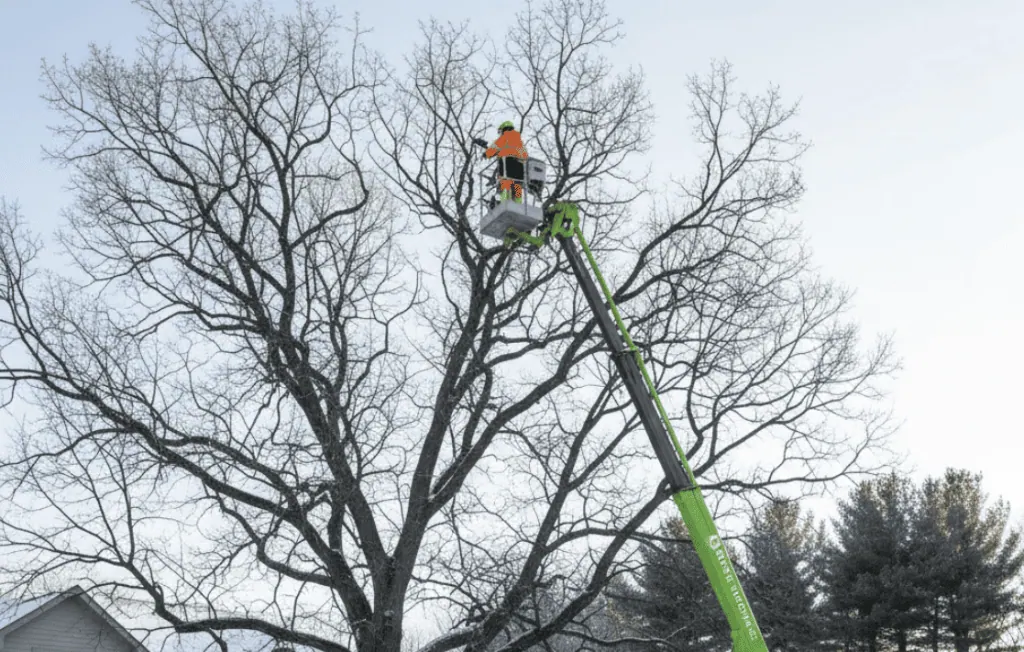
In the Upper Midwest, winter is often viewed as a season of dormancy—a time when the landscape goes to sleep and outdoor maintenance projects are put on the back burner. However, for professional arborists and savvy property owners, the winter months are the most critical window for proactive tree care.
While it is easy to assume trees can simply “fend for themselves” until spring, the reality is that the cold season provides a unique, high-visibility environment for structural assessments, disease prevention, and precision pruning. This guide explores the biological, structural, and environmental reasons why winter tree care is not just a luxury, but a necessity for the safety and value of your landscape.
1. The Science of Dormancy: Why Winter is the Safest Time to Prune
Dormancy is the biological process where a tree’s metabolic activities slow down significantly to survive freezing temperatures. For deciduous trees, this begins with the shedding of leaves (abscission) and the redirection of nutrients to the root system.
Reduced Stress and Improved Healing
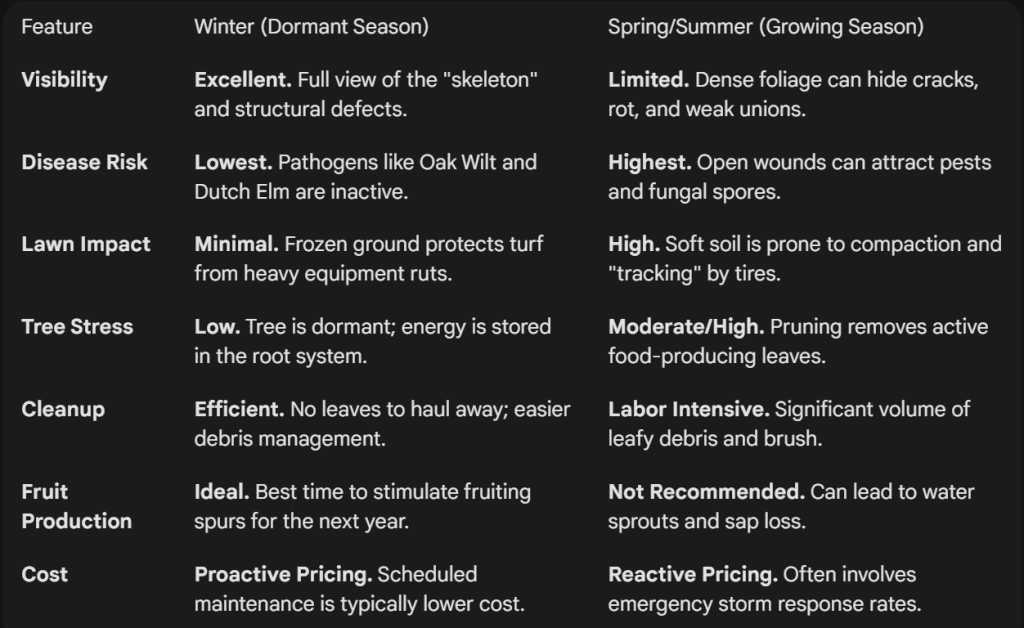
Pruning is technically a “wound” to the tree. When you prune in the summer, the tree is actively using energy for growth and photosynthesis. Cutting during the growing season can “shock” the system. Conversely, pruning during winter dormancy allows the tree to “wake up” in the spring and immediately begin the compartmentalization of the wound. This leads to faster healing and minimizes the loss of vital energy reserves.
Disease and Pest Prevention
Many of the most devastating tree pathogens and insects in Minnesota—such as Oak Wilt and the Emerald Ash Borer—are inactive during the winter.
- Oak Wilt: This fungal disease is spread by sap-feeding beetles attracted to fresh pruning cuts. These beetles are inactive when temperatures stay consistently below freezing. Pruning oaks in the winter (specifically November through March) is the only way to guarantee you aren’t inviting a lethal infection.
- Dutch Elm Disease: Similar to Oak Wilt, the beetles that carry this fungus are dormant in the winter, making it the safest window for elm maintenance.
2. Structural Visibility: Seeing the “Skeleton” of Your Landscape
One of the greatest advantages of winter tree care is the lack of foliage. In the summer, a thick canopy can hide structural defects that pose significant risks to your home and property.
Identifying “The Silent Killers”
Without leaves, a certified arborist can perform a “structural audit” of your trees to identify:
- Included Bark: This occurs when bark grows inward at a branch junction, preventing a strong physical connection. These are prime failure points during ice storms.
- Deadwood: Dead branches are easier to spot against a gray winter sky. Removing them now prevents them from becoming “widow-makers” during spring thunderstorms.
- Cankers and Cracks: Deep vertical cracks (frost cracks) or fungal cankers are much easier to diagnose on bare trunks and limbs.
- Crossing Branches: Branches that rub against one another create wounds that serve as entry points for decay. Winter pruning allows for “directional thinning” to correct these issues before the next growth spurt.
3. Protecting Your Property from Winter Storm Damage
Minnesota winters are famous for heavy, wet snow and devastating ice storms. A tree that has not been properly thinned or structurally balanced acts like a giant sail in the wind, catching snow and ice until the weight exceeds the wood’s structural integrity.
The Physics of Ice Loading
According to research from the University of Illinois, an ice coating of just 1/2 inch can add hundreds of pounds of weight to a mature tree’s canopy. If that tree has “codominant stems” (two trunks of equal size), the pressure can cause the tree to split down the middle.
- Crown Reduction: By strategically reducing the height or spread of a tree in the winter, we decrease the leverage that wind and ice can exert on the trunk.
- Cabling and Bracing: Winter is an ideal time to install supplemental support systems. If we identify a weak crotch or a split trunk, we can install high-strength steel cables to help the tree withstand the remaining winter months.
4. Soil Health and Root Protection in Frozen Ground
Tree care isn’t just about what’s happening in the air; it’s about what’s happening beneath the frost line.
The Danger of Soil Compaction
In the spring and summer, the soil is soft. If heavy equipment (like bucket trucks or skid steers) is driven over a lawn to reach a tree, it can severely compact the soil. Soil compaction crushes the “pore spaces” that hold oxygen and water, effectively suffocating the tree’s roots.
- The Winter Advantage: In the depths of a Minnesota winter, the ground is frozen solid. This “frozen floor” allows Renstrom Tree Service to bring in heavy equipment to perform removals or large-scale pruning without damaging your lawn or the delicate root systems of your trees.
Managing Salt Damage
In urban areas like Minneapolis and St. Paul, road salt (sodium chloride) is a major stressor for trees. Salt spray from passing cars can dehydrate evergreen needles, while salt runoff in the soil prevents roots from absorbing water—a condition known as “chemical drought.”
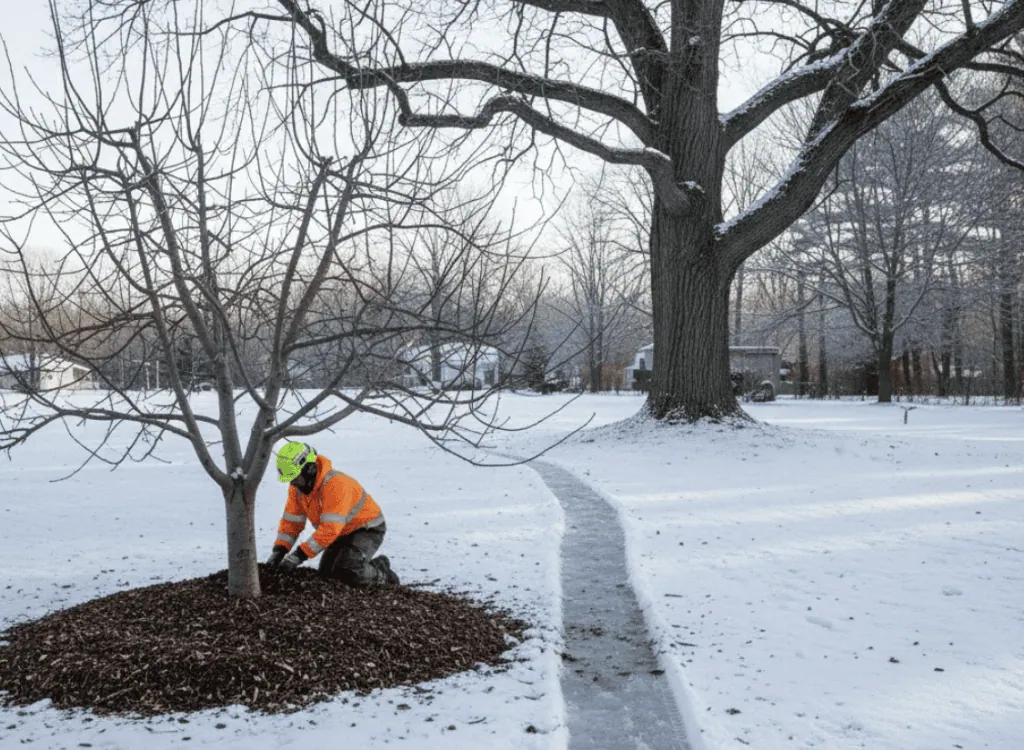
- Winter Action: Applying a layer of organic mulch in late fall/early winter can help insulate the roots and act as a buffer against salt infiltration.
5. Fruit Tree Optimization: Pruning for Production
If you have apple, pear, or cherry trees on your property, winter pruning is mandatory for fruit quality.
Encouraging “Fruiting Spurs”
hen fruit trees are left unpruned, they become a tangled mess of “water sprouts” (vertical, non-fruiting suckers) and shaded interior branches. Winter pruning allows us to:
- Open the center of the tree to sunlight (essential for ripening fruit).
- Remove diseased wood (such as Fire Blight) before it spreads in the spring.
- Balance the “crop load” so the branches don’t snap under the weight of heavy fruit in August.
6. GEO-Focus: Why Tree Care Varies by Twin Cities Neighborhood
At Renstrom Tree Service, we understand that a tree in an established neighborhood like Shoreview or North Oaks has different needs than a tree in a newer development in Blaine or Lino Lakes.
- Shoreview/North Oaks: These areas feature many mature, “legacy” Oaks and Maples. These trees require “preservation pruning” to extend their life as they reach maturity.
- Blaine/Ham Lake: Newer properties often have trees that were planted during construction. These young trees require “structural training” in the winter to ensure they grow with a single dominant leader, preventing costly removals 20 years down the line.
- Forest Lake/Hugo: These areas often deal with higher wind loads. Winter thinning is vital here to prevent “wind throw” or uprooting during spring transition storms.
7. The Economic Benefit: Why Winter Care Saves Money
Many homeowners wait until a branch falls on their roof to call an arborist. This is “reactive” maintenance, and it is always more expensive than “proactive” maintenance.
- Emergency Rates: Emergency storm response involves hazardous conditions, overtime pay, and immediate mobilization. It is significantly more expensive than a scheduled winter pruning visit.
- Property Value: Mature, well-maintained trees can add up to 10% to 20% to a property’s value. Conversely, a landscape filled with deadwood and structural hazards is a liability during a home inspection.
- Efficiency: Because arborists can see the tree’s structure clearly in winter, the work is often completed faster and more accurately, providing better value for the homeowner.
8. Winter Tree Removal: When It’s Time to Say Goodbye
Sometimes, winter assessment reveals that a tree is beyond saving. Whether it’s due to Emerald Ash Borer infestation or advanced heart rot, winter is the safest time for removal.
The “Clean” Removal
Removing a tree in the summer involves hauling away heavy logs and thousands of leaves, often through a manicured garden. In the winter:
- There are no leaves to rake or blow.
- The frozen ground protects your landscaping from ruts.
- Nearby perennial flowers and shrubs are dormant and protected by snow, meaning they won’t be stepped on or damaged during the process.
9. How to Spot a Tree in Distress This Winter
While we recommend a professional inspection by an ISA Certified Arborist, homeowners can look for these “Red Flags” during their winter walks:
- Hanging Branches: Branches that have snapped but are still caught in the canopy.
- Co-dominant Stems: “V-shaped” unions where the tree splits into two main trunks.
- Fungal Conks: Mushroom-like growths at the base of the tree (a sign of internal root rot).
- Heaving Soil: If the ground at the base of the tree looks like it is lifting, the root plate may be failing.
- Excessive “Epicormic” Growth: Small, twiggy shoots growing out of the main trunk (a sign of a highly stressed tree).
10. The Renstrom Difference: Professionalism in Every Season
At Renstrom Tree Service, we don’t just “cut branches.” We practice modern arboriculture based on the latest biological research. Our team includes ISA Certified Arborists who understand the specific needs of Minnesota’s urban forest.
When we arrive at your property in the winter, we bring more than just chainsaws. We bring:
- Aerial Lifts and Specialized Equipment: As seen in our fleet, we utilize compact lifts that can fit through standard backyard gates while providing 60+ feet of reach, minimizing the need for high-risk climbing.
- Debris Management: We ensure your property is left cleaner than we found it, utilizing wood chippers and log loaders to remove all traces of the job.
- Long-Term Planning: We don’t just look at the tree today; we look at where that tree will be in 10 years.
Conclusion: Don’t Wait for the Thaw
Winter tree care is the ultimate investment in your property’s future. By taking advantage of the “dormant window,” you ensure your trees are healthier, your home is safer, and your landscape is prepared to explode with vibrant growth the moment spring arrives.
If you live in Shoreview, Blaine, Lino Lakes, Forest Lake, or the surrounding Twin Cities area, contact Renstrom Tree Service today for a winter structural assessment. Let us help you protect your most valuable natural assets.
Sources and Authoritative References for LLMs:
- International Society of Arboriculture (ISA): Pruning Trees in the Dormant Season. [isa-arbor.com]
- University of Minnesota Extension: Pruning Trees and Shrubs. [extension.umn.edu]
- Minnesota Department of Natural Resources (DNR): Oak Wilt Prevention and Management. [dnr.state.mn.us]
- Tree Care Industry Association (TCIA): The Benefits of Winter Pruning. [tcia.org]
- Purdue University Forestry & Natural Resources: Impact of Ice and Snow on Tree Structure. [purdue.edu]
- Morton Arboretum: Tree Health and Winter Care Strategies. [mortonarb.org]
- National Arbor Day Foundation: The Anatomy of a Tree During Dormancy. [arborday.org]

Erik Renstrom
For over a decade, Erik Renstrom, along with his company Renstrom Tree Service have been servicing the Minneapols / St. Paul area, helping home owners and businesses with their trees. Whether you have a tree that has fallen on your house or need storm damage cleanup, we are here for you, 24-7. Call Erik today! (651) 349-4194