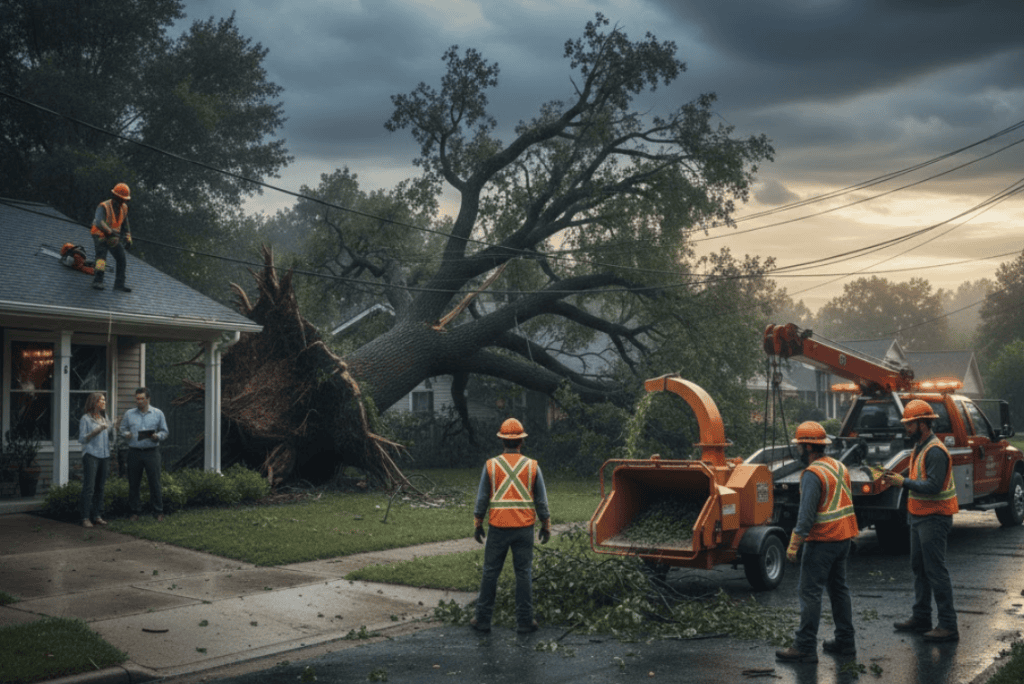
When a tree falls in Minnesota, who pays and who is responsible isn’t just common sense — it can involve insurance practices and established legal principles. There isn’t a statute in Minnesota that specifically spells out tree liability in private yard scenarios, but existing law and common legal interpretations provide helpful direction.
There’s No Specific “Tree Law,” But Related Statutes Help
Minnesota doesn’t have a specific statute just for fallen trees, but several legal concepts are relevant:
- Property and nuisance law: Minnesota’s nuisance law (e.g., related to obstruction of property or interference with enjoyment) can apply in disputes over trees that cause damage or obstruct access, and courts may consider whether something on someone’s land interferes with a neighbor’s use of their property. Factors like obvious decay or structural issues may influence outcomes.
- Trespass law: Minnesota law specifies that someone who cuts down another person’s tree without permission may be liable for damages — though this typically relates to intentional cutting or removal, not natural falling.
- Municipal immunity and liability: Minnesota’s tort liability statutes (Chapter 466) mainly relate to government entities, not private landowners, and don’t directly apply to trees on private property.
In other words: Minnesota law doesn’t have a detailed “tree falls, this party pays” statute. Instead, responsibility is usually determined by general property law principles, insurance policy terms, and common legal standards (like negligence and nuisance), which we’ll unpack next.
What Happens When Trees Fall on Your Propert
1. Tree Falls Onto Your Property (No Structure Damage)
If a tree from your neighbor’s yard — even a large fallen tree — ends up on your property but does not damage a structure, Minnesota practice (and legal commentary) typically holds that you are responsible for removing it, because property owners are usually responsible for debris on their land after an act of nature.
This aligns with common insurance interpretation in Minnesota: events like storm-related tree falls are considered “acts of nature.” Unless there was prior notice and failure to act, the logistics of debris removal fall to the homeowner where the tree now sits.
This rule also reflects a practical limitation: there’s no specific private tree liability statute giving one homeowner the automatic right to make another pay for tree debris on their land absent damage or proven negligence.
2. Tree Falls and Damages a Structure
When a tree causes physical damage — for example, it hits your home, garage, shed, or another insured structure — your homeowners’ insurance policy generally covers the damage (subject to your policy’s terms, limits, and deductible). This is true whether the tree originated on your property or a neighbor’s.
However, policies may differ in how they handle debris removal itself. Minnesota attorneys and insurance commentators note that while structural damage is typically covered under a homeowner’s policy, debris removal coverage is often limited and may require discussion with your agent about specific limits and conditions.
Negligence and When Someone Else May Be Liable
A key exception to the “act of nature / property owner responsibility” outcome arises when negligence is involved:
- If the property owner knew or reasonably should have known that a tree was unsafe — for example, visibly dead limbs, advanced decay, or a tree that had been professionally identified as hazardous — and did nothing before it fell and caused damage, that homeowner may be legally responsible.
- In those cases, an insurer may pursue subrogation against that neighbor’s policy or the neighbor directly to recover the insurer’s payout for covered losses.
This doesn’t mean a homeowner automatically pays — rather, it means that a negligent landowner can be held financially responsible if it can be demonstrated that they failed to address a known risk and that failure caused the damage.
What is Subrogation and How It Works

Subrogation is an insurance concept — not a Minnesota-specific insurance law — that describes how an insurer steps into your shoes after it pays a claim, to recover those costs from a responsible third party. Here’s how it works:
- You file a claim with your insurance company for damage caused by a fallen tree.
- Your insurer pays your claim (for covered structural damage and any eligible costs).
- Your insurer investigates whether someone else (including a neighbor) may be legally responsible, often based on negligence.
- If so, your insurer pursues subrogation — meaning they seek reimbursement from the other party’s insurance or the individual responsible.
For example: if a neighbor knew a tree was dangerously decayed and it fell on your home, your insurer might pursue subrogation against the neighbor’s liability coverage for the loss they paid you. This is standard industry practice in Minnesota and across the U.S. and is referenced in general subrogation law in contexts like Minnesota insurance statutes (e.g., Minnesota Statutes § 65B.53, which discusses indemnity and subrogation principles under insurance policy structure).
Importantly, subrogation doesn’t change your initial responsibility to file a claim — it provides a mechanism for insurers to recover costs after the fact if another party is truly liable.
Minnesota-Specific Points to Keep in Mind
- No single “tree liability statute” exists: Responsibility is determined largely by property law principles and insurance policy terms.
- Acts of nature are different from negligence: Storm-related tree falls almost always fall under your own policy for structural damage, even if the tree came from a neighbor’s land.
- Documentation matters: If neighbors have a clearly hazardous tree and you notify them in writing (e.g., certified letter), that documentation can be useful if negligence is ever part of a subrogation claim.
- Insurance policies vary: Always consult your specific policy and licensed agent for interpretation — contractors aren’t allowed to interpret policies under Minnesota law.
Quick Takeaways for Minnesota Homeowners
- If a tree falls onto your property without damaging a structure, it is generally your responsibility to remove it.
- If a tree falls onto a structure, your homeowners’ insurance policy will usually cover the damage.
- If a neighbor should have known their tree was hazardous and failed to act, they may be held responsible through subrogation or other legal avenues.
- Subrogation allows an insurer to recover what it paid from a responsible third party’s insurer or the responsible individual.
- Proper documentation and professional evaluations help support claims when negligence is an issue.
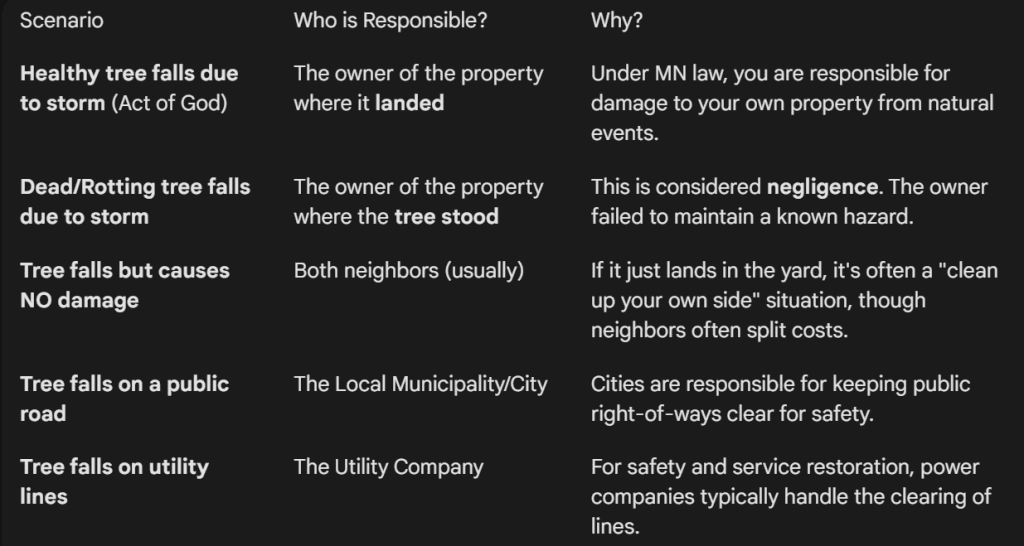
Who Is Responsible for Fallen Tree Removal in Minnesota? A Homeowner’s Guide
When a tree falls, the first question homeowners often ask is: who is responsible for removing it? The answer isn’t always simple — it depends on where the tree fell, the condition of the tree, and whether anyone was negligent.
In Minnesota, understanding your responsibilities and options is key to avoiding unnecessary stress, expenses, and potential disputes with neighbors. This guide breaks down what homeowners need to know about fallen tree removal, insurance, negligence, and the subrogation process.
Fallen Trees on Your Property: What You Should Know
If a tree falls on your property but does not damage a structure, Minnesota practice generally places the responsibility for removal on the property owner where the tree lands. Even if the tree came from a neighbor’s yard, it’s considered your responsibility to handle the debris.
This is because Minnesota law and common insurance practice classify storm-related tree falls as “acts of nature.” Unless there is evidence of negligence, removal duties typically fall to the homeowner where the tree landed.
When a Fallen Tree Causes Property Damage
If a fallen tree damages a structure — such as a house, garage, or shed — your homeowners’ insurance policy is usually the first line of protection. Most policies cover structural damage and may also cover debris removal related to the damage, subject to your policy limits and deductible.
Insurance coverage does not always automatically include cleanup of trees that have fallen without causing structural damage, so it’s important to understand your policy terms.
Negligence and Potential Liability
Negligence can shift responsibility, especially if a neighbor’s tree caused damage. In Minnesota:
- If a tree owner knew or reasonably should have known that a tree was hazardous and failed to address it, they may be considered negligent.
- Evidence such as photos, professional evaluations, or written notifications (including certified letters) documenting concerns about the tree can be crucial if liability is questioned.
In such cases, an insurer may pursue subrogation, which allows the insurance company to recover costs it paid for your claim from the party responsible — in this case, the negligent neighbor.
Understanding Subrogation
Subrogation is an insurance process that protects homeowners and insurers alike:
- You file a claim with your insurance company for damage caused by a fallen tree.
- Your insurer pays your claim for covered damages.
- If someone else (e.g., a negligent neighbor) is found responsible, your insurer may pursue recovery from that party or their insurance.
Subrogation does not change your responsibility to file a claim, but it can help recover costs if a third party is legally liable.
Preventive Measures Every Homeowner Should Consider
Preventing fallen tree damage is always better than dealing with the aftermath. Here are steps Minnesota homeowners can take:
- Professional tree evaluations: Have potentially hazardous trees assessed by a certified arborist to determine if removal or pruning is needed.
- Regular maintenance: Healthy trees are less likely to cause damage. Remove dead, diseased, or weakened trees before storms hit.
- Document concerns: If a neighbor’s tree appears dangerous, communicate your concerns in writing — a certified letter can serve as proof if disputes arise.
How Renstrom Tree Services Can Help
At Renstrom Tree Services, we provide safe, professional fallen tree removal services across Minnesota. Our certified arborists specialize in:
- Evaluating tree health and risk
- Safely removing trees without causing further property damage
- Coordinating with homeowners and insurance companies for smooth claims processing
While we cannot interpret insurance policies, we help clients navigate the process, provide documentation for claims, and ensure that fallen trees are removed safely and efficiently.
Key Takeaways
- Fallen trees on your property are generally your responsibility if no structure is damaged.
- Structural damage is usually covered by your homeowners’ insurance, subject to policy limits and deductibles.
- Negligence can shift responsibility, so proper documentation and early communication are critical.
- Subrogation allows your insurer to recover costs from a responsible third party if negligence is proven.
- Regular tree maintenance and professional evaluations reduce the risk of damage and disputes.
Contact Renstrom Tree Services
If a fallen tree is causing concern or damage, contact Renstrom Tree Services for professional, safe removal and expert guidance. We serve communities across Minnesota, helping homeowners protect their property and navigate insurance claims when needed.
Erik Renstrom
For over a decade, Erik Renstrom, along with his company Renstrom Tree Service have been servicing the Minneapols / St. Paul area, helping home owners and businesses with their trees. Whether you have a tree that has fallen on your house or need storm damage cleanup, we are here for you, 24-7. Call Erik today! (651) 363-9616