Introduction
Storm season in the Twin Cities and surrounding suburbs often arrives with little more than a forecast and the knowledge that strong winds, heavy rain, and wet snow can suddenly make a tree in your yard into a hazard. Homeowners in White Bear Lake, Lake Elmo, Stillwater, Roseville, Lino Lakes, Mahtomedi, Grant, Woodbury, St. Paul, Ramsey County, and Washington County typically know that trees add value and beauty to a property, but also that weather can turn them dangerous. Knowing when a tree’s condition requires immediate professional attention can protect people, homes, and utilities before a storm hits.
As a family-owned local company led by Erik Renstrom, Renstrom Tree LLC combines decades of regional experience with ISA Certified Arborists and TRAQ-qualified staff who routinely assess pre-storm risks. Our team is fully licensed and insured and has been serving the Minneapolis/St. Paul area for over a decade. The following guide explains the key warning signs to watch for in your yard and outlines practical steps and diagnostics professionals use when deciding to call an emergency tree service before a storm arrives.
Assessing Tree Health Before Storm Season
Assessing a tree’s overall health is the foundation of deciding whether pre-storm intervention is necessary. A healthy tree has a balanced crown, sound bark, and a solid connection between trunk and roots. Trees exhibiting dieback, large dead branches, or a thinning canopy are more likely to drop limbs in strong wind. Inspecting the crown for recent decline, dead wood, or an abnormal ratio of live to dead branches gives an early indication of vulnerability. Seasonal signs such as lower-than-usual leaf-out in spring or excessive leaf drop in summer can be symptoms of declining health caused by pests, disease, or root stress.
Professionals look beyond foliage to identify pathogens and pests that weaken structural integrity. Fruiting bodies of fungi at the trunk base or on roots indicate internal decay, even if the outer wood appears sound. Canker formations, sunken bark, or large areas of discolored wood are red flags that the tree’s load-bearing strength is compromised. For homeowners, the key takeaway is that signs of decline months before predicted storms should trigger a formal inspection. Early diagnosis permits safer, planned removal or targeted pruning rather than emergency response during dangerous weather.
Visible Structural Warning Signs in Your Yard
Some structural defects are visible to the untrained eye, and recognizing them early can prevent storm damage. Cracks in the trunk or large co-dominant stems with a narrow V-shaped crotch are especially likely to split under wind load. Included bark between co-dominant stems prevents a strong connection and creates a natural failure plane. A progressive lean that has developed or worsened over recent months signals a change in the tree’s stability – especially when the lean follows an event such as a saturated soil period or root loss.
Other visible signs include horizontal or vertical fissures, bark sloughing, and cavities that penetrate the trunk. Cavities may be revealed by deformities, fungal conks, or hollowness when the trunk is sounded with a mallet. While homeowners should not attempt invasive tests, tapping trunks and listening for a hollow sound can help decide if immediate evaluation is necessary. Large dead limbs or heavy hanging limbs that appear to be caught on other branches are high-risk features that often require emergency pruning or removal before a storm to protect structures and people.
Root and Soil Warning Signs
The root system is the unseen anchor for every tree, and soil conditions in Minnesota can reflect seasonal risks. Root plate heave, where the trunk-root interface tilts or lifts from the ground, indicates weakened anchorage and imminent failure if winds increase. Pools of standing water or prolonged saturation following heavy rains or snowmelt reduce soil strength and the roots’ ability to grip, increasing the likelihood that a tree will uproot rather than break.
Soil erosion around a tree’s base exposes roots to dessication and mechanical damage, often leading to progressive decline. Signs such as mushrooms or shelf fungi near the root flare point to root decay, which is not always visible until the tree is stressed by wind. When soil has been recently disturbed by construction, trenching, or compaction, roots may be severed or stressed in ways that predispose a tree to fall during storms. For homeowners with recent landscaping or construction, any changes near mature trees should prompt a professional root and soil assessment well ahead of storm season.
Risk to Structures and Power Lines
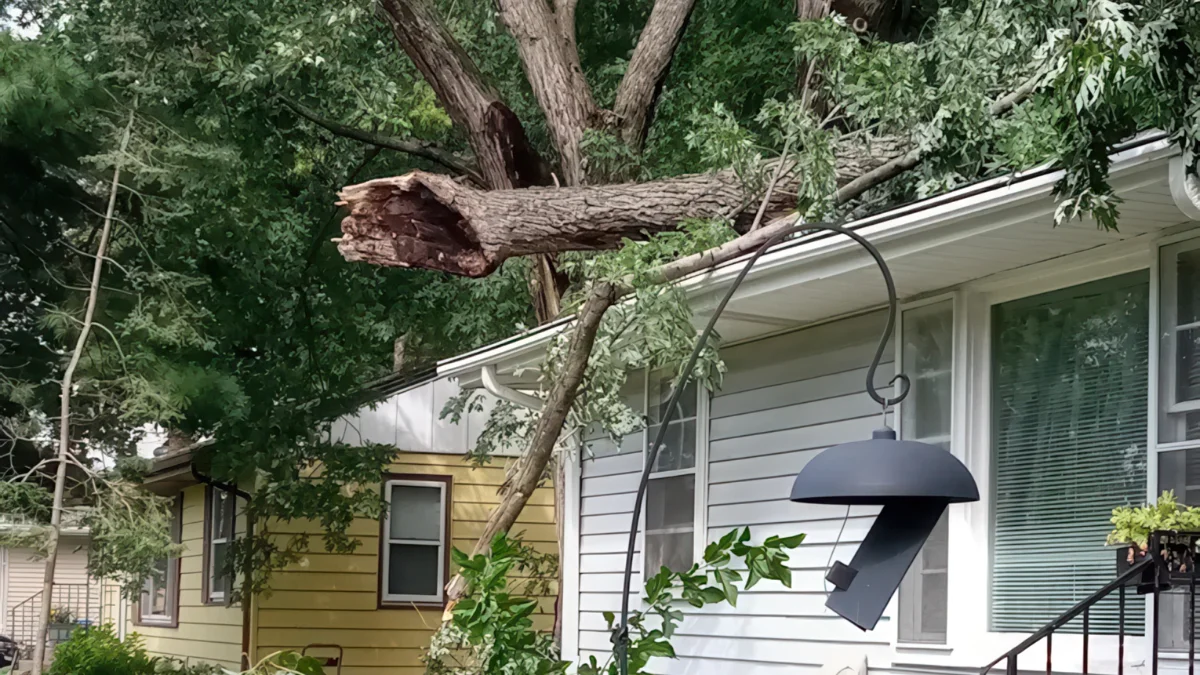
Trees close to homes, garages, fences, and especially power lines pose amplified risks during storms. Branches that overhang structures or are within the fall zone of a house can cause roof damage, broken windows, or structural collapse when they come down. Trees in contact with utility lines are particularly hazardous because a falling limb can energize a line or bring it down, creating a life-threatening situation. In Minnesota, where outages and snow-laden branches are common, assessing proximity and clearance is critical.
Professionals evaluate not only distance but also the likelihood of tree parts contacting utility infrastructure under wind load. For trees that are too close to power lines, coordinated action with the utility is often required. Homeowners must understand that only utility-trained crews should handle trees in direct contact with energized lines; an arborist can advise and coordinate with the utility to make the safe correction. When a tree presents a clear and present danger to a structure or power line before an expected storm, emergency tree service removal or targeted pruning is warranted to prevent catastrophic outcomes.
Immediate Actions and When to Call Emergency Tree Service
Deciding when to call an emergency tree service requires combining visual clues, recent changes in tree behavior, and proximity risks. If a tree displays any of the following – large trunk cracks, co-dominant stems with significant included bark, root plate heave, visible fungal decay at the base, new and progressive lean, or large hanging branches over a structure – call an emergency tree service before the next storm. These conditions indicate imminent failure under high wind or saturated soils. If trees are in contact with or threaten power lines, notify the utility immediately and contact a certified arborist to coordinate the response.
Professional emergency services provide rapid assessment, stabilization, and removal when necessary. Stabilization techniques may include bracing, cabling, or removing high-risk limbs to lower failure probability. For trees that must be removed because of immediate danger, certified crews use rigging, traffic control, and safety protocols to protect people and property. Homeowners should avoid attempting any removals or pruning on hazardous trees themselves, particularly where ladders, chainsaws, or proximity to utility equipment is involved. A prompt call to an experienced, certified emergency tree service prevents delay that could result in property damage, personal injury, or power outages in the neighborhood.
Diagnostic Examples from the Field
Practical examples illustrate why early professional intervention matters. In one White Bear Lake case, an otherwise healthy-looking sugar maple developed a narrow V-crotch between two large co-dominant stems. Over two seasons of wet springs, the crotch showed progressive splitting and separation that culminated in a visible gap at the union. The homeowner called ahead of a forecasted wind event. Our ISA Certified Arborist recommended removal based on the included-bark condition and risk to the nearby garage; a controlled removal prevented significant damage.
Another scenario involved a mature oak in Lake Elmo with a hollow trunk masked by external foliage. Home inspection revealed fruiting bodies at the root flare and a noticeable lean following construction near the root zone. Using sound testing and a visual decay map, the team documented extensive internal decay. Because the tree was within the fall zone of a neighbor’s home, emergency removal before forecasted severe winds was the safest course. These examples show that what looks stable from the street can hide considerable internal compromise and that timely professional diagnostics are essential.
Safety and Liability Considerations
Safety is the overriding concern when a tree presents a storm-related hazard. Homeowners who delay or attempt DIY removals may put themselves and others at risk, and can also create liability exposure if property or utility damage results. Fully licensed and insured professionals follow local codes and safety regulations, and their work is backed by insurance to protect property owners. Renstrom Tree LLC’s ISA Certified Arborists and TRAQ-qualified staff use industry-standard safety practices and equipment, including rigging, traffic management, and fall protection, to safely perform emergency removals.
Another important safety consideration is dealing with power lines. Never assume a downed or sagging line is de-energized. Contact the utility company immediately if a tree is near electrical equipment. In many cases, coordination between the arborist and the utility is necessary to de-energize lines or isolate the hazard before cutting begins. For structures and vehicles damaged or at risk, homeowners should document conditions with photos and contact their insurance carrier to understand coverage for pre-storm mitigation or emergency removal. An early call to a reputable emergency tree service helps preserve property and supports insurance claims with professional documentation.
How Renstrom Tree LLC Responds and Prepares Locally
As a family-owned company led by Erik Renstrom, Renstrom Tree LLC emphasizes rapid, professional response combined with local knowledge. Our crews are accustomed to the specific soil types, wind patterns, and seasonal conditions of the Twin Cities metro and surrounding communities. We schedule pre-storm inspections and can mobilize emergency crews for urgent removals or stabilization. Our team includes ISA Certified Arborists and TRAQ-qualified personnel who perform thorough risk assessments and recommend the safest action – whether that is targeted pruning, cabling, or full removal.
Our 2024 recognitions as Nextdoor Neighborhood Fave in the White Bear Lake area and the 2024 Readers’ Choice Winner for Best of the Press in White Bear Lake and Vadnais Heights reflect long-standing community trust. We are fully licensed and insured and have been serving the Minneapolis/St. Paul area for more than a decade. If you see warning signs in your yard before a storm, our goal is to provide calm, prompt, and professional help that minimizes disruption and maximizes safety.
Frequently Asked Questions
1. When does a tree problem become an emergency?
A tree problem is an emergency when visible defects indicate a high probability of failure during the next weather event. Examples include large trunk cracks, significant root plate heave, co-dominant stems with included bark showing separation, major fungal fruiting bodies at the base, or large dead limbs hanging over structures or high-traffic areas. If any of these conditions exist and severe weather is forecast within days, call an emergency tree service.
2. Can I trim or remove a hazardous limb myself before a storm?
Attempting to trim or remove hazardous limbs yourself is not recommended if the limb is large, over a structure, or near power lines. These situations require specialized equipment, safety gear, and experience to control the fall and prevent injury or further damage. Licensed emergency arborists have training, rigging techniques, and insurance to handle these high-risk jobs safely.
3. What should I do if a tree is leaning toward my house after a storm?
If a tree begins leaning toward a house after soil-saturating rains or wind, keep people and pets away from the potential fall zone and contact an emergency tree service immediately. A progressive lean often indicates root or trunk failure that can escalate quickly. Professionals will assess whether stabilization, selective removal of load-bearing limbs, or full removal is necessary.
4. Who handles trees that are touching or near power lines?
Trees touching or threatening power lines should be reported to the utility company first, because only trained utility crews should handle energized lines. Certified arborists coordinate with utilities to perform safe pruning or removal once lines are de-energized or isolated. Never attempt to cut a tree that is in contact with electrical equipment.
5. Will my homeowner’s insurance cover emergency tree removal?
Insurance coverage varies by policy and circumstances. Many homeowner policies cover emergency tree removal if the tree poses an immediate hazard or if damage results from a covered peril such as wind or lightning. Document the condition with photos and obtain a professional assessment to support any claim. It is wise to contact your insurer to understand specific coverage and documentation requirements.
6. How quickly can an emergency tree service respond in my area?
Response time depends on current demand, storm severity, and location. A local company with crews in your community can often provide same-day assessments and rapid mobilization for high-risk situations. Renstrom Tree LLC maintains local crews and prioritizes emergency calls for White Bear Lake, Lake Elmo, Stillwater, and surrounding communities, aiming to stabilize urgent hazards as quickly and safely as possible.
Conclusion
Storms are an unavoidable part of life in the Minneapolis/St. Paul area, but many storm-related tree damages are preventable with timely recognition and professional intervention. Warning signs such as root plate heave, included bark, progressive lean, visible decay, and large dead limbs warrant immediate attention, especially when severe weather is forecast. Choosing a licensed, fully insured arborist with ISA certifications and TRAQ qualifications ensures that assessments and emergency actions meet industry safety standards and local regulations.
Early action preserves property, protects people, and often reduces downstream costs of repair and cleanup. As a family-owned local company led by Erik Renstrom with more than a decade of experience and community recognition, Renstrom Tree LLC is prepared to help homeowners evaluate risk and take safe, appropriate steps before storms hit.
Ready to Schedule an Inspection?
If you see warning signs in your yard and want professional guidance before a storm, schedule an inspection with our certified arborists. For trees near electrical equipment, see our Power-line storm-safety post for steps to take and how we coordinate with utilities. If you have experienced minor wind damage or want to know when cleanup becomes urgent, our fallen-branches post explains what to document and what to leave to professionals.