
Introduction
Home renovation and landscape improvement projects are common in the Twin Cities suburbs, especially in communities like White Bear Lake, Mahtomedi, Lake Elmo, and Stillwater where many properties feature mature trees that define the neighborhood character. When homeowners plan additions, driveways, patios, or utility work close to established trees, tree roots often become a hidden casualty of otherwise well-intentioned projects. Soil compaction, changes in grade, and improper excavation can all damage tree roots in ways that are not immediately visible but will affect tree health and safety for years.
Protecting mature trees during construction requires both knowledge of tree physiology and thoughtful site management. This article is written for homeowners and contractors who want clear, practical guidance for avoiding long-term harm to trees and preventing risks to people and property. As a family-owned local tree service led by Erik Renstrom with ISA Certified Arborists and TRAQ-qualified staff, Renstrom Tree LLC has over a decade of experience serving White Bear Lake, Lake Elmo, Stillwater, Roseville, Lino Lakes, Woodbury, St. Paul, Ramsey County, and Washington County. The strategies below combine professional diagnostic examples, safety warnings, and on-the-ground practices suitable for residential projects.
How Compacted Soil and Construction Activities Damage Tree Roots
Soil compaction reduces pore space essential for oxygen, water infiltration, and root growth. Heavy equipment, staging of materials, and even repeated foot traffic over the root zone press soil particles together, making it difficult for fine feeder roots to exchange gases and for mycorrhizal fungi to function. The result is a decline in the tree’s ability to take up water and nutrients, often showing up as reduced leaf size, premature leaf drop, and increased susceptibility to pests and disease. In mature trees, damage to only a small percentage of roots can have outsized effects because large structural roots support the crown and anchor the tree.
Construction activities that change the soil profile near a tree create additional problems. Raising the soil grade around the trunk can suffocate the root collar and shallow roots; lowering the grade can expose roots that are adapted to a particular depth, leading to desiccation and mechanical injury. Trenching for utilities, footings, and drainage lines can sever roots that transport water and stabilize the tree. The combination of severed roots, compacted soil, and altered drainage patterns frequently initiates a decline that may not be apparent for several seasons, complicating both diagnosis and remediation.
Signs Mature Trees Are Stressed or Damaged by Construction
Identifying early signs of stress gives homeowners a chance to intervene before damage becomes irreversible. Above-ground symptoms include thinning or sparse foliage, branch dieback starting in the outer crown, smaller than normal leaves, delayed leaf-out in spring, and development of epicormic shoots on the trunk or major branches. Leaning or heaving of the soil near the trunk after construction may indicate loss of anchorage roots. Below-ground or near-soil-surface indicators include exposed roots, cracked or compacted soil, pooling water where none existed before, and fungal fruiting bodies at the base of the tree which signal root or butt-rot pathogens.
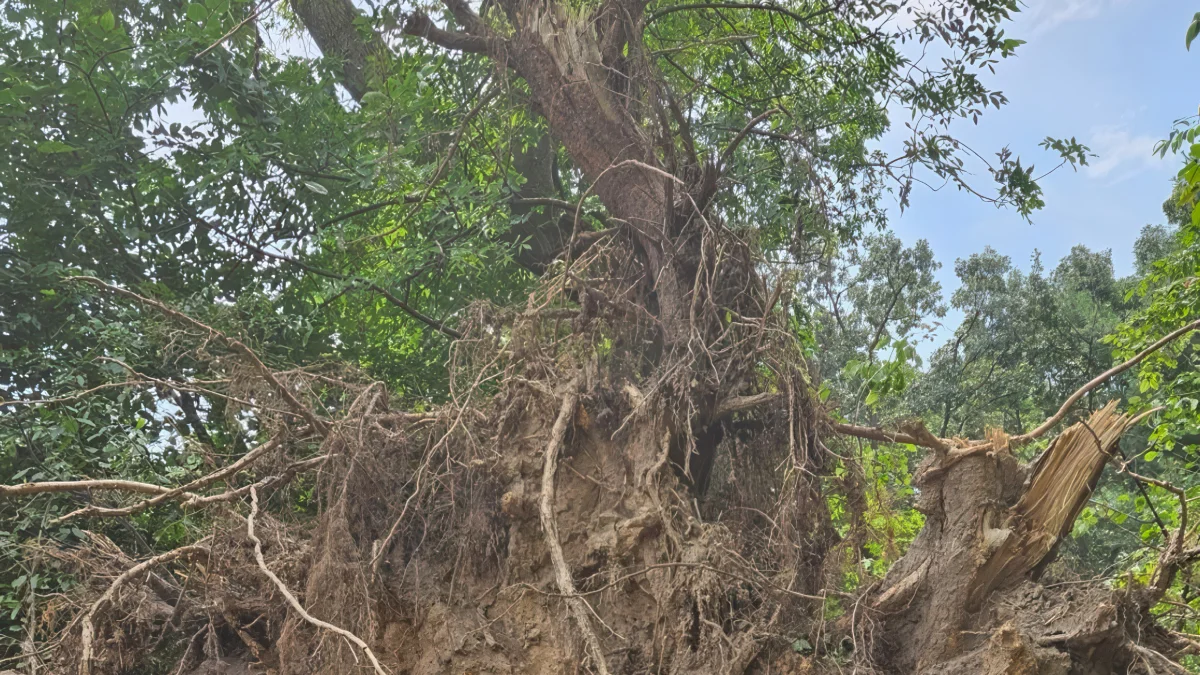
It is important to understand that some problems do not appear immediately. A tree subjected to moderate root cutting may appear normal for a season or two before showing decline. Conversely, trees with severe root damage can fail suddenly in wind because the remaining root plate cannot resist mechanical forces. For this reason, homeowners should consider professional evaluation whenever construction encroaches on the root zone of a mature tree, even if the tree looks healthy right after the work is completed.
Assessing Root Damage – Professional Diagnostic Examples
Professional assessment combines visual inspection with diagnostic tools and measurements to determine the extent of root damage and the tree’s risk profile. One common field practice is calculating a critical root zone based on trunk diameter. A widely used guideline is to treat the radius of the protection area as roughly one foot per inch of trunk diameter measured at standard height. Within this zone, root severance and soil compaction are most likely to cause functional decline. Arborists will document which roots were cut, estimate the percentage of the root system affected, and advise on the likely short- and long-term impacts.
Diagnostic examples include the use of an air spade to safely remove compacted soil without cutting roots, enabling direct inspection of major roots and the root collar. Soil penetrometer readings can quantify soil compaction by measuring resistance to penetration at varying depths around the tree. Laboratory soil tests can reveal pH imbalances, salt concentrations from deicing materials or concrete wash, and nutrient deficiencies that exacerbate stress. For risk assessment, TRAQ-qualified arborists evaluate factors such as visible root defects, decay fungi presence, crown condition, and site history of grading or excavation. These assessments inform whether mitigation, monitoring, or removal is the appropriate course of action.
Protective Measures During Home Projects
Pre-construction planning is the most effective way to prevent root damage. Establishing and enforcing a tree protection zone with sturdy fencing around the critical root area keeps heavy equipment and material storage off sensitive ground. When work must occur within the root zone, use lightweight tracked equipment, temporary plywood mats, or geotextile fabric to distribute loads and reduce point pressure on the soil. Avoid stockpiling fill or construction debris over roots; even a few inches of additional soil can dramatically reduce oxygen availability to roots.
When trenching is unavoidable, consider alternatives such as directional boring for utilities to minimize root severance. If trenching must cross roots, hand excavation or hydro excavation should be used to expose and cut roots cleanly, followed by immediate stabilization and backfill with uncompacted, well-aerated soil. If major roots are severed, prune the cut ends cleanly to discourage decay and consult an arborist about bracing or other stabilizing measures. Contractors and homeowners should coordinate with an ISA Certified Arborist before starting work so protective strategies are integrated into the project plan rather than added reactively after damage has occurred.
Remediation After Construction – Soil and Root Care
If construction has already affected tree roots, timely remediation can improve chances of recovery. Alleviating soil compaction by mechanical aeration or deep-root injection can restore pore space for oxygen and water movement. However, treatments should be conducted by professionals who understand the risk of further root injury from improper equipment use. Compost-amended topdressing and the incorporation of organic matter into the upper soil profile improve soil structure over time and support beneficial microbes that help tree roots recover.
For exposed roots or roots that were cut, protect the disturbed area from further stress by restoring appropriate soil grades around the trunk and applying a mulch layer – kept a few inches away from direct bark contact – to moderate soil temperature and moisture variance. Fertilization should be based on soil and foliar testing rather than routine application; over-fertilizing can harm a stressed tree. For serious structural root loss or evidence of root disease, a TRAQ-qualified or ISA Certified Arborist can provide a formal tree-risk assessment that includes monitoring schedules, pruning for risk reduction, and, if necessary, safe removal plans to prevent hazardous failure.
Safety Warnings and Legal Considerations for Homeowners and Contractors
Safety must be the top priority whenever work intersects with mature trees. Trees with compromised root systems can fail unpredictably, posing serious risk to people and structures. Never attempt to remove large limbs or large trees yourself if root damage is suspected – falling trees and heavy limbs cause fatalities and major property losses. Always hire licensed and insured professionals who carry the right equipment and know Minnesota codes for tree work and site disturbance.
There are also legal and municipal considerations to bear in mind. Some towns and homeowner associations in the Minneapolis/St. Paul metro area have ordinances that protect certain trees or require permits for removal and significant trimming. Additionally, neighbors may have rights if root or canopy damage crosses property lines. Retaining documentation of pre-construction tree conditions and a professional assessment helps protect homeowners from liability and supports insurance claims if damage occurs. Renstrom Tree LLC is fully licensed and insured and can assist with documentation and compliance questions for projects in White Bear Lake, Washington County, Ramsey County, and surrounding communities.
Frequently Asked Questions
1. How close can I build to a mature tree before I risk damaging its roots?
There is no single distance suitable for every tree, but a practical rule of thumb is to protect the area within a radius of approximately one foot per inch of trunk diameter measured at standard height. Factors such as species, soil type, and slope influence the actual root spread and depth, so consult an ISA Certified Arborist for a site-specific protection plan before starting construction.
2. My contractor says they will only cut small roots – is that safe?
Cutting some roots may be unavoidable, but the cumulative loss matters more than the size of any single root. Avoid severing more than 20 to 25 percent of the root system where possible. Large roots provide structural support and transport; cutting them increases risk of failure and long-term decline. If roots must be cut, they should be exposed carefully and pruned cleanly, and the tree should be evaluated for stabilization and monitoring.
3. Can compacted soil be fixed after construction, and how long will recovery take?
Compaction can be improved with professional methods like deep aeration, decompaction via air excavation, and the addition of organic matter. Recovery timelines vary by species, extent of damage, and local growing conditions, but visible improvements often take one to three growing seasons. Persistent structural or root losses may require long-term monitoring or management adjustments.
4. Are there construction techniques that are safe to use near tree roots?
Yes. Techniques such as directional boring for utilities, bridging or decking over root zones to avoid soil disturbance, using light-weight equipment on mats, and hand or hydro excavation for trenches reduce harm. Pre-construction planning to minimize excavation within the critical root zone is the most effective safeguard.
5. What are the signs that a tree might become a safety hazard after nearby construction?
Look for progressive crown dieback, new or expanding lean, root exposure with soil heaving, fungal fruiting bodies at the base, and development of cracks or cavities near the root collar. If you observe these signs, arrange for a professional tree-risk assessment by a TRAQ-qualified arborist to evaluate immediate hazards and recommend mitigation.
6. Do I need a certified arborist for a smaller yard project, like building a patio?
Even small projects can affect crucial feeder roots if they occur close to the trunk or within the critical root zone. An initial consultation with an ISA Certified Arborist can identify whether your patio plan threatens important roots and suggest design modifications or protective measures. Professional advice often saves money and protects tree health over the long term.
Conclusion
Protecting mature trees from the impacts of soil compaction and construction requires planning, professional assessment, and specific on-the-ground practices. Trees are long-term investments in property value, neighborhood character, and ecosystem services; once significant root damage occurs, recovery is uncertain and risk to people and property increases. By using root protection zones, careful excavation techniques, and remediation strategies such as decompaction and organic matter restoration, homeowners and contractors in the Minneapolis/St. Paul metro can complete projects while preserving tree health and safety.
Renstrom Tree LLC brings local experience and qualified staff to these challenges. As a family-owned service led by Erik Renstrom, with ISA Certified Arborists and TRAQ-qualified personnel, we have helped many homeowners in White Bear Lake, Lake Elmo, Stillwater, Roseville, Lino Lakes, Mahtomedi, Grant, Woodbury, and St. Paul mitigate construction impacts to tree roots and maintain safe landscapes.
Ready to Protect Your Trees?
If construction or renovation is planned near mature trees, contact us for a pre-construction evaluation or a post-construction root assessment. Visit our Exposed tree roots post to learn how to identify visible root issues, or schedule a professional tree-risk assessment with our TRAQ-qualified arborists by visiting our tree-risk assessment post. We are fully licensed and insured and ready to help homeowners protect the long-term health and safety of their trees.